Group 1B Film Opening Sequence


Group 1B Film Opening Sequence

Showing posts with label Alex Sahin Contributions. Show all posts

Thursday, March 7, 2013

Final title font

We decided to use the Northwood High font for titles in our opening sequence.

We chose it because:
  • It's easy to read
  • Has a horror theme
  • Suits the style of our opening sequence
  • Has lowercase letters
Many of the horror fonts that we looked at had only capitalized letters which we felt wouldn't be as effective, as it wouldn't be as enigmatic as having the film title in all lowercase. Our chosen font also looks quite rough, with smudges and gaps in the 'ink' which we also thought suited our idea.


Tuesday, March 5, 2013

Final title order

After looking into opening titles of other film sequences we decided that this would be our final title order:

  1. Distributor
  2. Production Company
  3. Director
  4. Screenplay
  5. Actor names
  6. Music
  7. Make-up
  8. Costumes
  9. Edited by
  10. Special Effects
  11. Set Decorator
  12. Cinematography
  13. Director of Photography
  14. Art Direction


Thursday, February 28, 2013

Fixing Grainy Shots in After Effects


One problem that we experienced when we were taking our shots was the 'grainy' look that occurred in particularly dark shots such as the one below. We managed to fix this in most of our shots in our real shoot by using the lighting kit, however we still had the same problem where we weren't able to use the lights.

To fix the shots we added a Remove Grain effect to the footage in Adobe After Effects. We then adjusted the level of noise reduction and the number of passes to get the best result. Finally we replaced the original footage with the new edited shot in Premiere. Overall there is a noticeable difference in the quality of the shots and they look much better than before.


Before
After

Mise-en-scene of bedroom

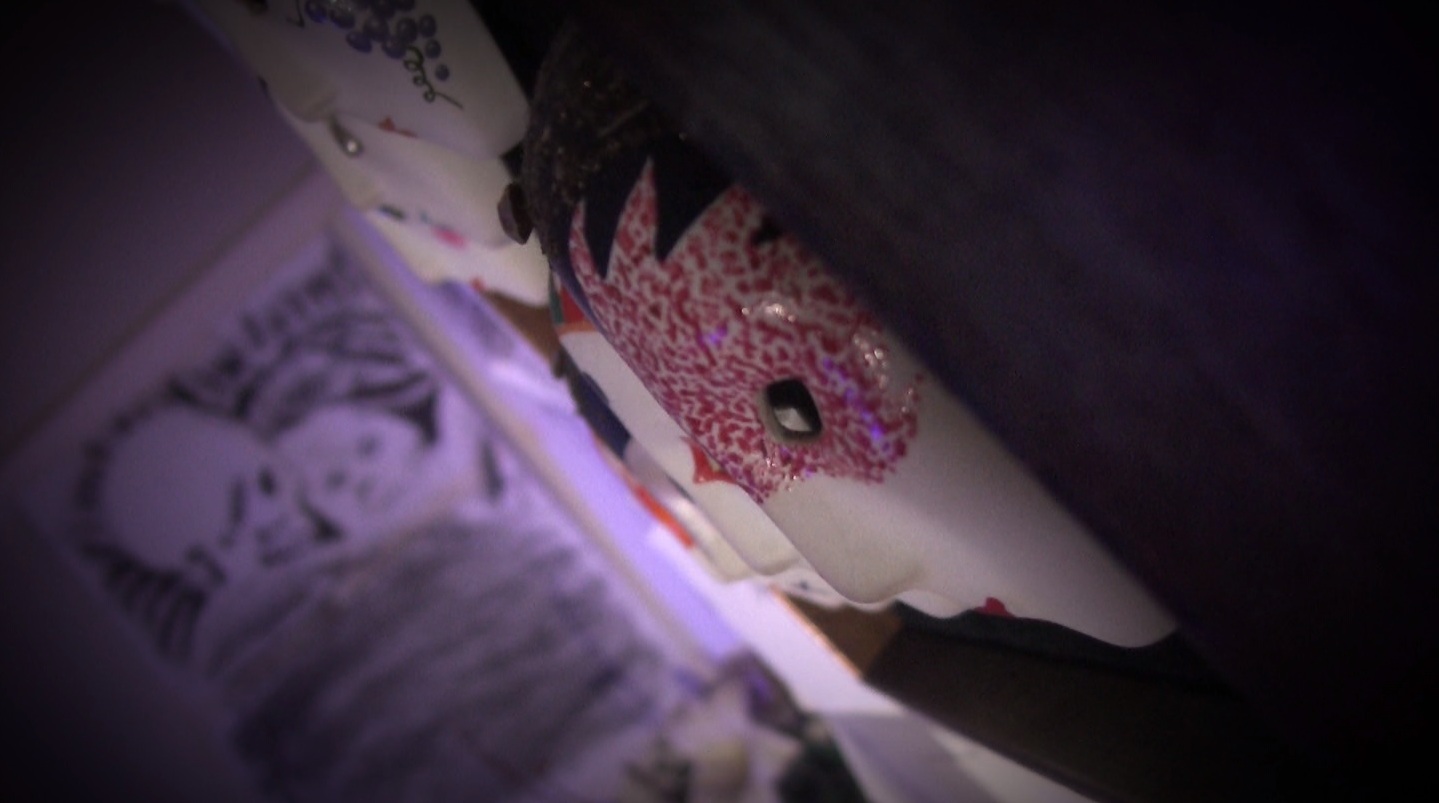
The bedroom was always intended to look spooky, thus creating an eerie atmosphere that would appeal to the audience and add layers to the character. In this case, we wanted to portray the protagonist as disturbed, but not enough to make the audience believe she is crazy.


The drawings are inspired by conventional drawings from other films such as The Ring and Insidious, but are kept monochrome and look more thought out as our protagonist is much older and would be drawing more meaningful and evolved than what a ten year old would draw.


Other objects such as the teddy bear, plants and masks represent other layers to her, for example femininity and youth which also counteract with her dark side portrayed by the drawings towering over her.

Wednesday, February 27, 2013

Improving the Lighting


On the set of our real shoot, we experimented with different light set ups to get the effect that we wanted.  In the end we decided on using two lights for most of our shots, one with a blue filter to create a blue tint and a second light to fill and reduce shadows. We mainly had to focus on the lighting in the bedroom, because we wanted it to look particularly dark and mysterious. It took us a while to get the right position to set them up but eventually we managed to get the correct angle. For some of the shots such as the one from outside the house looking into the window, we decided that the natural lighting inside the house would look effective on its own and that we didn't need to use the lights.

Overall the lights helped a lot, because they allowed us to get good quality shots which weren't grainy like in our previous shoots, but still created a dark horror atmosphere. However to improve our shots even more we will still need to use grading in post production. 

We gained a lot of inspiration for our lighting effects from a tutorial on YouTube showing how to illuminate an actor in the dark using just one light, and many ways to enhance the look. We were getting a lot of shadows on the walls with one light however so we decided to add in another. 


In some of our shots we wanted to make it seem like the room is being lit by a lamp in the corner with no other lighting, such as the shot where Violet looks through her bedroom window. To achieve this we set up a light next to the lamp, set the brightness quite low and shone it in the actor's direction. The result was the impression of a weak light source, but it was still quite dark around the room.

Improve Lighting


To get some ideas for the lighting in our opening sequence we looked at some video tutorials on Youtube.

This one was quite helpful as it demonstrated some lighting effects that can be used in the dark and with just one light. It can easily be achieved with the materials we have and is also effective. A light was shone on a table to create a softer light which was reflected on the actor's face, and interesting effects were created by using different materials on the surface of the table.

In our practice shoot we experienced some issues with lighting as we didn't have a lighting kit and couldn't create the low key effect that we wanted, however for our real shoot we are planning to use a light and blue filter to achieve a similar effect as in the video with a blue tint.


Things to Reshoot on our Back-Up Shoot

We made a list of things we felt needed to be re-shot at our back up shoot. * marks the important ones

  • *Slow pan up in bed while reading then stopping the pan whilst hearing the knock and looking at the clock (all in one shot)
  • *The outside of the house with the curtains OPEN
  • V*oyeuristic walking down the stairs with the lights on- do not pan
  • *Voyeuristic kitchen master- make sure no cars are passing by
  • Cut to Violet putting the water back in the fridge
  • *Driveway- make sure there are no lights are in other houses/car out of view
  • 5-10 seconds of looking into the spy hole
  • *End conversation without the blue light
  • Run into closet without the big lights
  • Establishing shot of house should change into POV shot

Saturday, February 9, 2013

Animatic

We created an animatic of our film which is like an animated storyboard. On our practice shoot we took stills of each shot and then made it into an animatic (shown below).


Friday, February 8, 2013

Rough Shot List

This is what we have as a starting shot list.

1.       MS Drawing cut to

2.       CU Drawing fade to black

3.       MCU Fade from black – Violet wakes up panting
4.   LS from end of bed revealing her drawings behind her

5.       CU Alarm clock – 3:07am

6.       CU Violet getting into shot of window

7.       XLS Empty driveway from across the street

8.       CU Girl reacting confused

9.       MLS Voyeuristic from outside of staircase window

10.   LS from staircase to kitchen

11.   MLS Voyeuristic from outside of kitchen window

12.   MS side-shot putting water filter jug back in the fridge when knocks are heard again.

13.   CU of picking up knife

14.   MS Violet slowly going towards door

15.   CU of Violet’s expression

16.   MS Violet going to look through spyhole

17.   Fish-eye lens empty drive way

18.   Fish-eye lens Violet’s eye frantically looking around

19.   MS Violet looking through spyhole when 3 really loud knocks occur. Violet jumps back extremely scared and drops knife, then turns to her right and runs towards staircase

20.   MLS Voyeuristic shot (setup from 9)  Violet hurryingly running up stairs

21.   MS to LS Going in bedroom, picking up phone and closing herself in the closet

22.   CU Black screen with her heavy breathing.  She presses on her phone making it light up her face. She calls her dad and pus the phone to her ear. He answers ‘do you know…’ and she replies… She suddenly stops and looks ahead with terror in her eyes. She turns the phone around so…

23.   CU … it illuminates the closet door. You hear faint scratching and 3 faint knocks.

Friday, February 1, 2013

Feedback on Presentation


After giving the presentation, our teacher gave us our feedback. We had a light system: green light meant we were good to go, amber light meant it is almost ready but a few changes need to be made and red light meant there were a lot of problems that needed fixing. Our group received a green light with certain conditions which was pleasing. From our feedback session this is what we gathered:


What we did well
What we need to improve on
·         Excellent research on target and secondary audience.
·         Excellent research on institutions.
·         Solid research on representation of social groups and characters.
·         Good analysis on how we want to attract TA through opening sequence.
·         Good use of film making techniques and technologies.
·         Improve intro conversation between doctor and dad so not too much is revealed and there is a loss of enigma.
·         Develop how we want to represent the setting.
·         Include more characters on film as a whole. (false villains etc)
·         Think about music more and how we intend to use it.

Thursday, January 31, 2013

Updated Script

From our feedback, we were told that the conversation between the doctor and dad at the beginning reveals too much of the narrative. To fix this, we would need to change the conversation to being simply between Violet and Dale. This would allow the audience to be introduced to characters and narrative without revealing important information.

*As the distribution credits are shown, a conversation between two people can be heard. No background music just their voices. This conversation is between Violet and Dale.*

Violet: Dad where are you it's getting late.

Dad: I got a later shift at work so I'll be home early in the morning, don't wait up.

Violet: Ughhhhhhh you always do this!

Dad: I promise you I'll make up for it, Violet, but I really have to go now I'll see you in the morning.

Violet: Dad pleas- *phone hangs up*

*Opening starts with a girl waking up from her bed, panting heavily. Her bedroom wall is covered in distressing drawings of creatures of sorts. There are 3 knocks on the door causing her to jerk her head. As she looks towards the alarm clock she sees that it is very late, 2am. Warily she gets up and peeks through the window to see the driveway and no one is there. As she is up, she decides to go downstairs and get a glass of water. Whilst doing this, she hears the 3 knocks again. They're louder this time. In fright, she grabs a knife from the kitchen and prepares herself to peer through the peep hole. The 3 knocks sound again, louder and more violent. Just a split second after the 3rd knock, she looks through expecting something/someone terrifying to be there but is greeted by an empty driveway and a seemingly calm night. Feeling more frightened than ever, she runs upstairs and hides in her closet from where she phones her dad. He picks up after a few rings.*

Dad: (voice through the phone) Violet do you know wha ti-
Girl: (breathing heavily and speaking in a rushed manner but in a whisper) Dad, I need you to come home right now. I think someone's trying to get in. I don't know. Please just come, I-

*Suddenly her head turns towards the closet door and she hears faint scratching. Her dad can be heard yelling through the phone, asking her questions. Then faintly but clearly the 3 knocks sound on the closet door. The title "hurting" appears.*

Wednesday, January 30, 2013

Hurting Presentation Slideshow

This was our film pitch that went with our handouts to the class and our teachers. Here we explained why we chose to do a horror film and how we plan to go about it. It also includes examples of other films we used as inspirations.


Sunday, January 27, 2013

Handout


One of our tasks was to create a handout to give to our class and teachers to explain our film in more depth and how we came to make certain decisions about the film. This is accompanied by a presentation that will go into the summarised points on the sheet in depth. This is the first side of the handout.


This is the second side of the handout:


Saturday, January 26, 2013

Supporting Characters


Dale


Dale is Violet's dad - He keeps her going and gives her moral support but ultimately has no control over the situation. Later in the narrative, the possessed Violet tries to kill Dale but she manages to regain control of herself before it's too late. This shows that, like our protagonist, he is very vulnerable and it is mainly down to Violet to rid herself of the possession.

The character Christopher in Silent Hill (2006) is an inspiration for Dale. In the film, when Rose goes to Silent Hill to search for her daughter, Christopher also scours the town for clues. Throughout the film he is disconnected with Rose, even at the end when she finally comes home but they cannot see each other. Likewise there is a mental barrier between Dale and Violet which prevents them from fighting the demon together.


Aidan in The Ring (2002) is another supporting character who can be compared to Dale, as he is the son of the protagonist Rachel, so both characters are connected to the protagonist as family. Aidan is precious to her and vice versa which creates some more suspense as we don't want to see either of them die. He gives Rachel advice and follows her around, however she must also protect him. Aidan is limited in the ways that he can help her and she must be the one to resolve the dilemma.


In Silent Hill: Revelation 3D, Sharon and Christopher take the identities of Heather and Harry Mason. Harry is a supporting character in this film and there is no longer a physical barrier between him and his daughter. Rather than having his own sub-plot and searching for clues, we see more of his involvement in the main plot. For example, Heather calls and asks him to pick her up when she suspects that she is being followed by Vincent, another student that she meets at school. He then gets abducted and we get the sense that both of their lives are in danger.

Vincent is another supporting character in the film, however at first he is introduced as an evil character who follows Heather - there is a lot of enigma surrounding him at the start. Later it is revealed that he is a cult leader's son and has been sent to bring her to back to the cult, which makes the audience even more suspicious of him, but he lets Heather escape at the cost of being captured himself. Heather helps Vincent later in the film by freeing him, which shows that he also has his flaws.

As Dale is her father, he should be quite close to Violet like Harry/Christopher. At the start he could be a distant character who motivates Violet to keep going, like Christopher, but he tries to save her and fails. When he is almost killed by the demon, this can show his weakness like Vincent when he is captured. Overall he supports Violet and is important to the plot, because without him she would have nobody to guide her.

Prompt Questions

We used these questions to explore our opening sequence choices in detail.

1) The action: identify the event your idea is based around; what actually happens?
  • A girl, who is defined as mentally disturbed, wakes up in the middle of the night to some knocking. She looks  through the window to see that no one is there. As she is awake, she decides to go to get a glass of water. As she does the knocking sounds again so she panics, grabs a weapon and looks through the peep hole to see nothing. Then she runs to her room and hides in her closet. She phones her dad for help but half way through the call she stops to hear scratching on the closet door which proceeds to three faint knocks on the closet door.

2) The theme(s): what should it make the audience think about or feel? What 'issues' will it raise?
  • One of the issues being raised is mental illness/psychotic behaviour. It should make the audience feel uneasy through out the clip. 
  • The fact that the audience can see, through certain iconography that the girl is mentally disturbed, should make them question what's real and what isn't. Is a 'monster' actually there trying to get her?

3) The narrative and structure: what happens? Will there be dialogue? What about diegetic/non-diegetic sound?
  • There will be dialogue in the beginning when two voices are discussing the main character's mental health. You only here the voices whilst the screen is black. Our opening is very sound based so there will be a mix of diegetic and non-diegetic sound. We will use non-diegetic sound to set the mood of the opening and create certain levels of tension. Sudden uneasy sounds will create a sense of fear etc. The 'entity' that is intruding the house will be shown through the sound of knocking. 

4) The character(s): who are they, identify their roles, what are their characteristics, including gender, appearance etc?
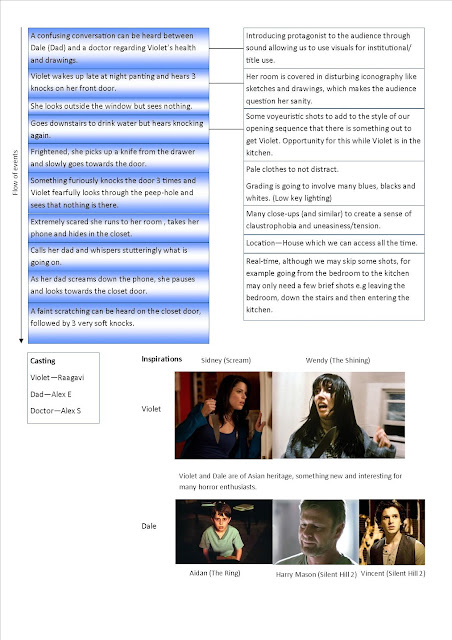
  • There is only one character shown in the opening which is the girl who is the main character throughout the film. She is the protagonist, who was initially a victim. She is an older teen with an asian heritage. She draws disturbing images that she places around her room.

5) The setting and choice of location: where is it set?
  • It is set in the main character's house and that is where all the action takes place.

6) The mise-en-scene: identify colours, lighting, dress codes, the overall visual look.
  • The grading of our film is going to involve many blues, blacks and whites. This is to give an eerie feel to the movie. The lighting is going to be quite low key. 
  • The protagonist will be wearing very plain clothes, with dark colours to not distract the viewer from her expressions.

7) The camera work: the style you are aiming for.

  • We hope to create a sense of uneasiness and tension with many close-ups and similar shots to create a sense of claustrophobia. This will be helped by the fact that some shots are shot inside a closet.
  • There will be some voyeuristic shots to portray that she isn't alone, and make her look like a victim. 

8) The editing: How will you tell the story? Will it be constructed in real-time, as one continuous sequence? What kind of visual style are you planning? How will the graphics/credits fit into the sequence, and what will they look like?
  • A lot of the credits will appear at the beginning when the drawings are being shown.

9) What are the influences behind your area?
  • Films that have influenced our idea is: The Woman In Black, The Others, 28 Weeks Later, Scream.
  • Characters that have influenced our protagonist: Sydney (Scream), Wendy (The Shining)

10) Has your idea been 'tested' against the 8 questions on page that outlines The Brief?

  • Is it practical? - Yes, one location, one actor, simple narrative.
  • Is it an idea that works to the strengths of the group? - Yes, familiar with horror genre.
  • Will it show off the skills you have learnt so far on the course? - Yes, closed location allows for many set-ups to be used. Continuity can be seen as everything is real-time..
  • Is it something you can reasonably shoot and edit in the time available? - Yes
  • Can you get access/ permission to shoot in the chosen location at the chosen times? - Yes, inside a home that we can access whenever we need, even outside chosen times.
  • Can you organize lighting to use in that location? - Yes, inside a home allows for easy movement and placement of lighting equipment without worry.
  • Have you included dialogue? - Yes, effective use that will introduce the audience to the narrative and protagonist, and also at the end create tension and fear.
  • Do you have guaranteed reliable actors? Yes - all actors needed are inside our group.

Naming the film

The name of a film is vital as it needs to capture the essence of the film without revealing anything. It also needs to intrigue the audience.

Horror film names tend to be:

  • Very literal: 'Haunting In Connecticut' 'One Missed Call' 'Evil Dead'
  • Focused on an object/person: 'The Ring' 'The Uninvited' 'The Others' 
  • One word: 'Sinister' 'Psycho' 'Priest' 
Ideas for our film name:
  • After Dark - Initially, our film was going to be called this, as the 'monster' chasing the main character around the house was real, so it would make sense that as if our film evolved into something like that, where the monster attacks people at night, and the girl was just another victim, that it would be called that. Later though, our film turned into a film about the girl, that tries to fight away the 'monster' who isn't physically real, but in her mind it is.
  • Sad Eyes - Creates upsetting emotions and can also be identified with the drawings around the girl's room and on the title pages, but doesn't seem like it would be a horror film just from the name. This could be good as it could potentially attract a bigger audience, but might also keep people at bay from watching it, as it may not fit the horror genre wholy and could be confusing.
  • Hurting - We liked this as it connotes both a mental and physical pain, where it can be seen in our opening sequence. It also sums up the notion of the main character being mentally disturbed without being too literal and ruining any chance of enigma being presented. It also creates strong emotions and can help the audience understand and relate with the character.
  • The Disturbed - This fits the horror convention perfectly. It describes the girl with as few words as possible and also appeals to our target and secondary audiences and fits audience expectations. On the other hand, horror titles like this, focus on the 'evil' of the film', not the victim/protagonist. She by doing this, we may confuse the audience into thinking the girl in the opening sequence is the monster of the film. This could confuse them even more since she portrays the victim in the opening.

In the end, we decided Hurting would be the best option for our film, as it portrays the emotions of not only the girl, but the film as a whole, and also in a way tells the audience how to feel about what they are watching. 

Thursday, January 24, 2013

Opening Sequence Title Count


I have looked at 2 horror films from different time periods, Silent Hill: Revelation 3D (2012) and Psycho (1960) to see what lines we can include in our own title sequence:


Wednesday, January 23, 2013

Film Treatment


 1. Who is your chosen target audience (both core and secondary markets)?

Target Audience: 16-24 M/F
Secondary Audience: Supernatural Horror fans            --->   The fact that we chose a supernatural/
                                   Suspense fans                                       psychological theme rather than gore
                                   Horror fans in general                          horror attracts many female/teen 
                                                                                                audiences that would otherwise be turned
                                                                                                off by gore elements.

2. Who is the media institution responsible for the distribution of your production?

Lionsgate - Distributes many horror films successfully (Texas Chainsaw, Saw films, Silent Hill etc)
                - Familiar with audience expectations for horror genre. 
                - Able to distribute globally. 

3. Describe your chosen genre and film idea.
  • Genre: Horror
  • Sub-genre: Supernatural/ Psychological
  • Log line: After losing her sense of reality, a mentally disturbed British girl is forced to deal with her fears, which in turn become more real and more frightening than she could ever imagine.
4. How do you plan to represent social groups in your sequence (eg gender, ethnicity, ability, class and status etc)? You may want to focus on one or two of these as your key representations.


  • We're planning to tackle gender stereotypes, mainly on the female gender. Already by portraying the main character as psychologically disturbed we are showing that she isn't the typical "innocent" victim. Although she's seen as vulnerable in our sequence, as to keep to some conventions so the audience can instantly familiarize with the character and genre, in terms of mise-en-scene, making her room reflect her personality with disturbing pictures would help make the audience think what we want them to think.
  • Also we are challenging stereotypes by using an actress who is from a different ethnic background to what is usually portrayed in horror movies. The audience don't usually see an Asian main female protagonist so it will be something fresh and new for them.

5. Explain the intended style and form of your opening sequence, including the conventions you intend to use, develop or challenge. This could include genre conventions, as well as the typical features expected in a film opening sequence.
  • Young girl is initially a victim (uses horror convention of a powerless girl being a victim) but then evolves into trying to fight mentally what it is that is trying to get her. This challenges the convention and develops the initial idea of a female victim into something new and interesting for an audience that has become accustomed to the convention. This way, we are also not changing it so much that it will become confusing and unappealing.
  • We want to keep the atmosphere of the opening quite tense and enigmatic as many horror openings do to grab a hold of the audience's attention as soon as it begins. This is something successful openings should do.
  • Using a house as a location is very conventional in horrors that are associated with hauntings. This will also assist us in being able to create an eerie and voyeuristic atmosphere as there will be a variety of places to film e.g from outside of the house looking inside. The grading of our opening is going to involve lots of dark blues and whites. 
6.  How will your film opening sequence attract/address your target audience?

  • Our opening sequence is going to shock the audience and create suspense. There will be a sense of danger as the girl is home alone and strange things are happening in her house. To build on this effect we will make use of conventional horror sounds and a shaky, chaotic filming style. Our main character/victim will appeal to our target audience a lot, because she is quite vulnerable but brave. In order to attract our secondary audience of horror fans, we will incorporate a lot of genre conventions and use elements of other horror films such as The Others and Paranormal Activity which they can relate to. 


7. What kinds of film making techniques and technologies do you wish to use in the construction of your opening sequence?
  • We will try and have continuity throughout the clip. For example when the girl is walking or running the shots of her should fit together smoothly and in time. 
  • We're going to use a fish eye lens effect in one of our shots to make it seem realistic when the girl looks through the spy hole on the door.
  • Our filming style is going to be voyeuristic to build suspense and suggest that some                                                                        one or something is in the house with her. 

8. How do your plans draw on work completed last term - both theory and practice.

  • First of all we are going to try to apply the principles of continuity editing which is a new concept that we discovered and studied last term. In order to achieve a continuous sequence we will create a story board and script, then group shots that are in the same location, which will also save some time and make our shooting more efficient. 
  • Last term we did a lot of work on genre conventions. We want the opening to have many conventions of the horror genre, as well as building on them and creating something new which will still be familiar to the audience.
  • In the Post-Production stage we will be using Adobe Premiere Pro to edit the sequence since we already have some experience with it. This will also help us with grading to achieve the low-key horror look.
  • Our knowledge of institutions was also important when deciding on our target audience and distributor. As we have learnt we targeted a primary audience (Males/Females aged 16-24) and a secondary (Horror fans).

Style & Technology


Style


Horror films rely on many camera and editing techniques to build suspense in the audience. For example, extreme camera movement can be used to create a sense of chaos. In the following clip from The Exorcism of Emily Rose, a shaky camera effect is used together with fast and sudden tilts and pans. The clip is edited with mainly fast cuts and there is juxtaposition between high and low angle shots. This shows that during climactic points in horror films, camera movement can be used to make the scene more effective and shock the audience. In our film opening we could use similar camera effects and a voyeuristic style to make it seem like the girl is being watched when in fact she is home alone.


Lighting is also an important aspect in the style of horror films. In the clip, low key lighting is used to create a dark atmosphere. The lightning outside creates some fast flashes of light however it is dark for most of the clip. This helps to build up mystery and enigma as we fear the unknown, and the audience’s imagination can fill in the blanks of what they can’t see which creates part of the horror experience. The contrast between light and dark especially with the frequent flashes of lightning creates a lot of suspense. We could incorporate the same style in our sequence but maybe using the light from her phone or a flickering broken light bulb instead and make full use of what resources we have.


Technology & Film Making Techniques

It would be a good idea to use low key lighting in our clip as it is quite conventional in horror films. To achieve the darkness that we need, we could film at night and use lights to create shadows. For the typical horror style we will need to use harsh lighting. As the clip is going to mainly focus on sound we will need some non-diegetic sound effects such as a screech or scream which we can get online or record with a mic. Finally, when we edit the clip we will use Adobe Premiere Pro. Due to our low budget, we won’t be needing much other technology.


An important shot we need to consider is when the girl looks out of the spy hole on the front door to see who’s there. We can use a ‘fish eye lens’ effect like in the image below to create the intended look. 


Thursday, January 17, 2013

Font ideas


Below are a few fonts to consider for use in our opening sequence:

From top to bottom: Nyctophobia, No Fear, Night of The Damned, Kerberos Fang, October Crow, Black Asylum, Damaged Sata, Vtks Scream, Courwette, Razor Keen, Aracnoide.


Many of these are quite conventional horror fonts which we could use for our title or credits. They show the horror theme quite well but are also clear and easy to read.

Vtks Scream seems as if it has been sketched, and could synergise with our concept of sketches and drawings in the protagonist/victim's room and title pages.